What Chrysanthemums Mean in East Asian Paintings: Key Points
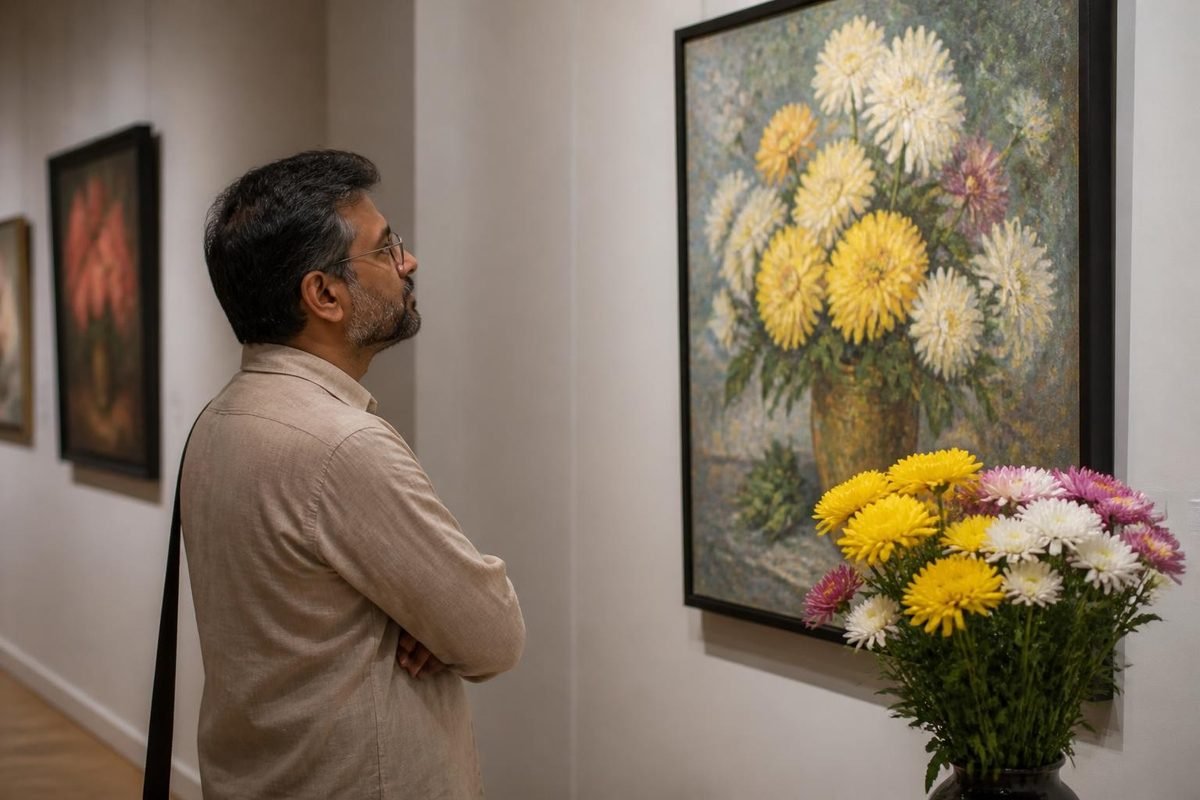
In East Asian paintings, chrysanthemums may stand for endurance, quiet independence, autumn beauty or long life. Their significance is not fixed, so the image, its cultural setting and any accompanying text all matter.
Autumn flowers and endurance
Chrysanthemums open in autumn, after many other flowers have finished blooming. Their late flowering gave painters a way to suggest persistence through cold weather and difficult conditions. Placing a blooming plant beside a stone or beneath a nearly bare branch can make the autumn setting more apparent.
In Chinese painting, the chrysanthemum belongs to the Four Gentlemen, together with plum blossom, orchid and bamboo. Painters used these plants to convey qualities they respected in a person. The chrysanthemum’s place in this group reflects its late-season bloom, rather than a competition with the full growth of spring.
Retreat, poetry and the countryside
Chinese poetry and art connect chrysanthemums with Tao Yuanming, who is also called Tao Qian. He turned away from official work and wrote about a quieter rural life. His poems contributed to the flower’s association with stepping back from public ambition and valuing a simpler existence.
Flowers painted beside a fence may point to this literary setting. The fence can carry more than a decorative role: it may recall a well-known passage where Tao gathers chrysanthemums by an eastern hedge and gazes toward distant mountains. Someone who recognizes the poem may read the scene as a statement of independence.
Longevity and regional associations
Long life is another possible meaning. In Chinese tradition, chrysanthemums are linked to the Double Ninth Festival, an autumn observance associated with wishes for longevity. A work created for a celebratory occasion may make use of this connection.
Japanese images may carry a different association. The chrysanthemum has a long history with the imperial household, and a stylized flower serves as its emblem. This background can be useful in interpreting Japanese art, but a chrysanthemum in a painting does not necessarily refer to the emperor. The artist may be showing autumn or the flower’s appearance instead.
Ways to interpret the image
Begin by describing what the painting actually shows. Then consider details about its context and artist, rather than assuming the flower has one standard meaning.
- Identify signs of the season. Late blooms, leaf fall or bare branches can place autumn at the center of the scene.
- Examine objects near the flowers. A fence, stones or a cup may suggest distinct settings and associations.
- Look for a title or inscription. A dedication or poem can provide evidence that the flower alone cannot offer.
- Find out where and when the work was made. Symbolic meanings can cross cultural boundaries, but they may change along the way.
Common questions about painted chrysanthemums
Does a chrysanthemum always represent longevity?
No. It can suggest long life, but the painter may instead be emphasizing the autumn season, resilience or a reference to literature.
Can flower color provide a definite answer?
Color may shape the mood, but it does not reliably identify one meaning. Read it together with the arrangement and any written text.
Are chrysanthemums included only as symbols?
No. Artists may also focus on the form of their petals, leaves and stems. A chrysanthemum can be a carefully observed plant as well as a subject with cultural associations.
Can a contemporary artist give the flower another meaning?
Yes. A modern painter may adapt earlier associations, alter them or depict the flower without intending a traditional message.
More to read: click here